
A Little Recap#
Winter 2025 was a really busy season. At work, we were pushing to release a big update to Forever Skies, and in October I’ve attended Game Industry Conference 2025 in Poznań, Poland where I held first Animatorowisko Animation Meetup
Since September, I’ve been training at Rigging Dojo in their Character Rigging 101 course, strengthening my fundamentas as I increasingly focus on the technical side of the animation pipeline. The course wasn’t really about finishing a polished rig from start to finish - it was about experimenting, testing, and building the problem-solving mindset of a TD.
Expectation vs Reality#
Before the course, I knew I understood what ecloses the rigging pipeline in general, but I felt like there were gaps I wanted to fix - especially when it comes to good, quality skinning. After spending last two and a half years in Blender, I wasn’t so sure I remember the Maya workflows as well as I’d like. Due to that, I was ready to dedicate serious free time - I’ve planned my Rigging Dojo attendance since around May 2025, so - I’ve had a few months to make plans to slot it to my calendar properly.
I wasn’t sure what to expect. I knew that this was so-called Animation Mentor for riggers, I knew I’ll learn a lot, but I only had the general outline & the name indicating we’ll start from scratch.
The reality is that this course is not hand-holdy at all - and that’s a very good thing! Let me copy-paste from my enrolling post what is (IMO) the most important quote from the whole course:
This course is not only to teach you how to rig, it is as much here to teach you how to learn about rigging.
– Brad Clark, Rigging Dojo’s Character Rigging 101 Mentor
And that’s really the truth about ths course. Each week had a topic in regarding to rigging process, theory (both written & video-based) and exercises. During the course,
we were expected to work on our rigs. I’ve got the mesh lended by talented Axel Bossard of this awesome Geralt, THANK YOU!"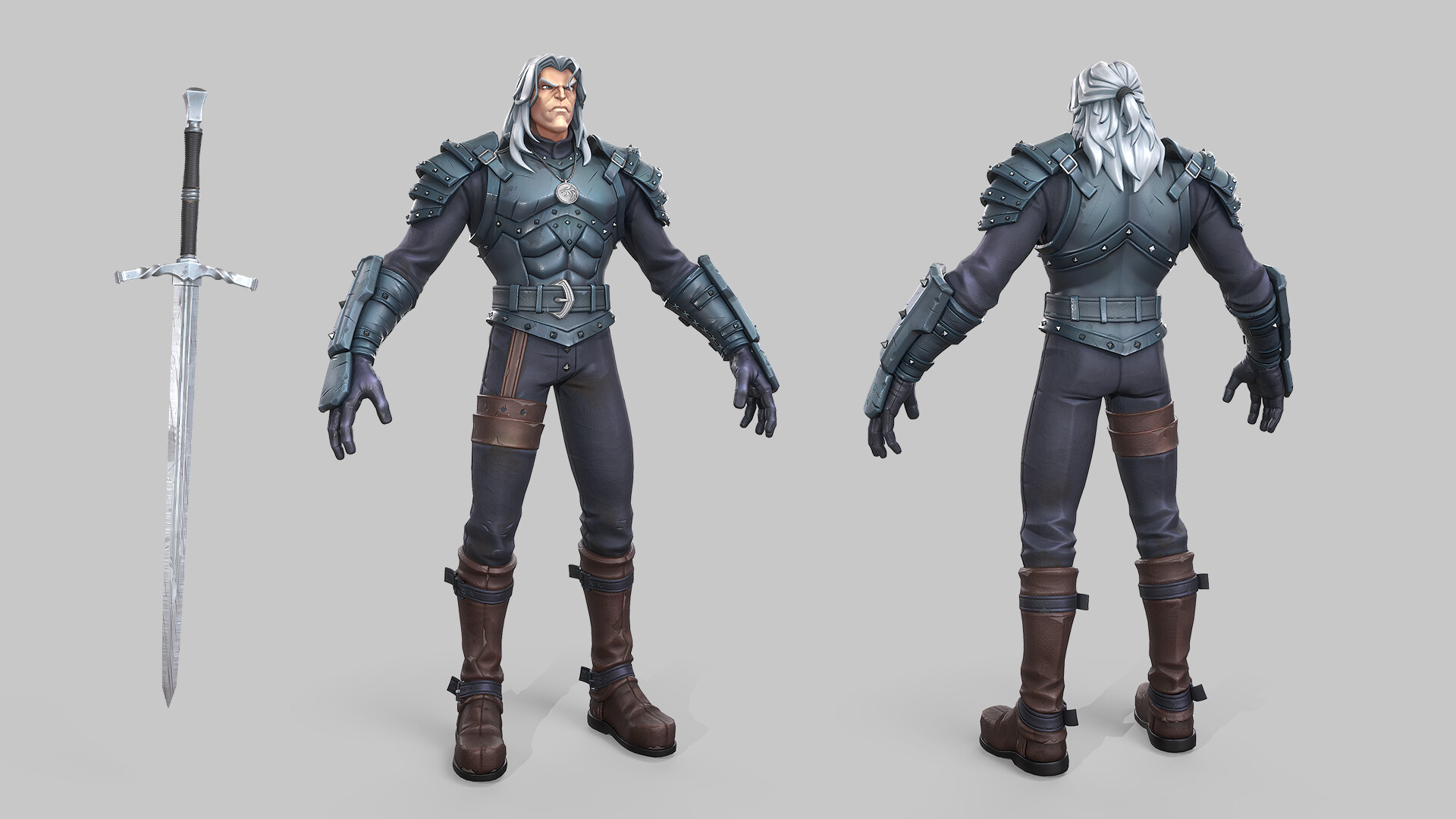
While this is a beautiful model with a good topology, it still posed a challange. As Brad said - the model itself is good, but there are lots of parts that are going to be tough to work with, so the entry bar is just set higher. With his guidance, I was able to push through and discover techniques that opened new ways of thinking about rigging.
Slowing Down & Facing Weak Spots#
My biggest weak spot in the rigging process was skinning - I always dreaded it. Before the course I just thought that it makes no sense, is very hard to do and I just suck at it. I thought, that we’ll just do reps on that and it’s only about practice. In reality, I’ve learned that everything that sums up to skinning is much more nuanced:
- Many of the meshes I’d use before werent properly prepared for rigging - and that can make skinning unnecessarily hard.
- The thing I was missing wasn’t the “painting” skill - it was techniques like simplifying shapes and weight transfering them.
- I thought I understood anatomy okay-ish, but exercises like drawing skeletons & muscles over references revealed gaps in applied knowledge.
- Not everything is fixable by “better weight painting”. You absolutely needs supporting joints & blendshapes to make things look right.
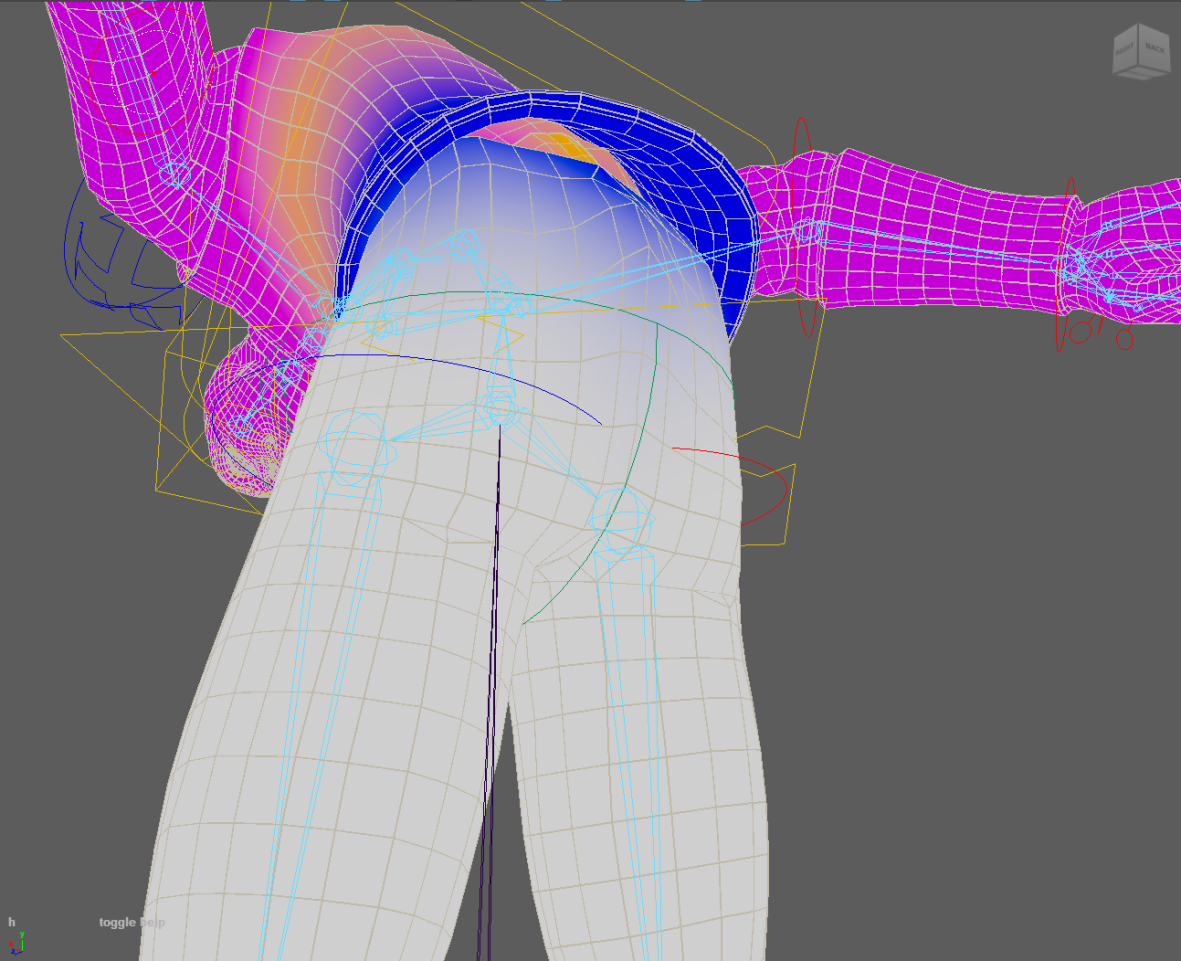
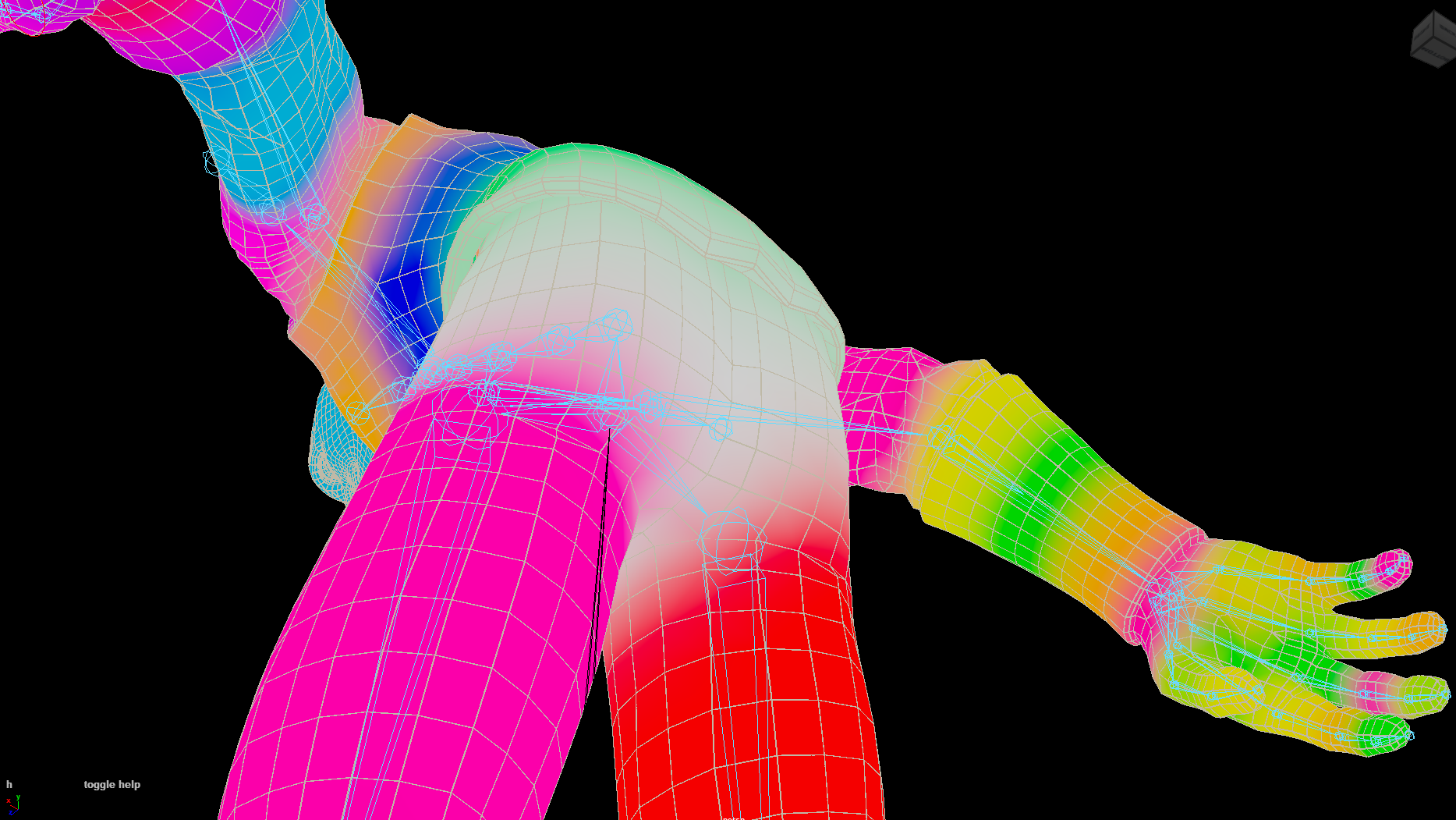
This course forced me to slow down and confront these issues head-on. I’ve struggled a lot when it comes to skinning and I still do, but the biggest difference is that I’ve started the course with dread of skinning and now I actuallly enjoy the skinning & deformation - I’d say that as of now, it’s probably the most interesting part of rigging for me. It became something meditative: I can put on music or a podcast and focus, layer by layer, refining the deformations with a properly done ROM (that was actually very helpful too).
It wasn’t just about the result - it was about the process and thinking like a TD: testing, iterating and solving problems - methodically.
The A-ha moment & Key Decisions#
The last two weeks of the course were the most pivotal. After preparing the mesh, creating the basic skeleton definition & setting up basic FK system - mostly to show how we thing about animator’s UX - we had a choice between two path to focus rest of our time on:
- Focus on skinning - explore blendshapes, corrective joints, work more with NGSkinTools
- Focus on IK setups and system blendng
IK setups seem to be relatively standardized. Every tutorial I ever watched seemed to follow the same or very similar practices and that have been consistend for decades. There’s a talk about Character Rigging Best Practices from GDC 2006!, and the same principle still agree. In general, seems like most of the rigging we do - from tools to principles - seem to be relatively consistent across all these years - I wonder if that’s because after all rigging is a support role to animators and when they’re comfortable in a workflow, they seem to rarely want to change it.
I felt like the real difference in modern rigs lie in deformation & skinning techniques - that’s something that expanded with beefier gaming setups & new engines.
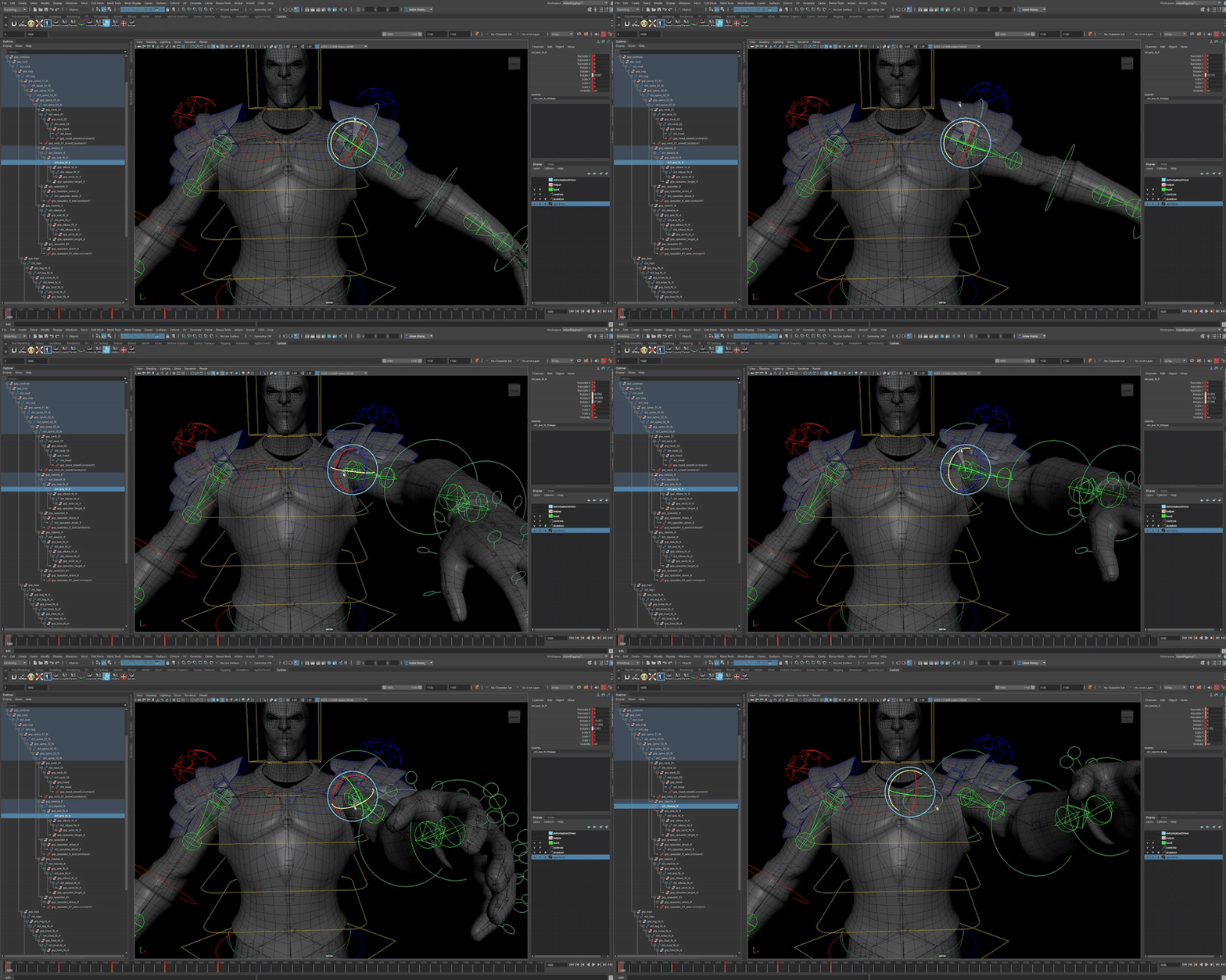
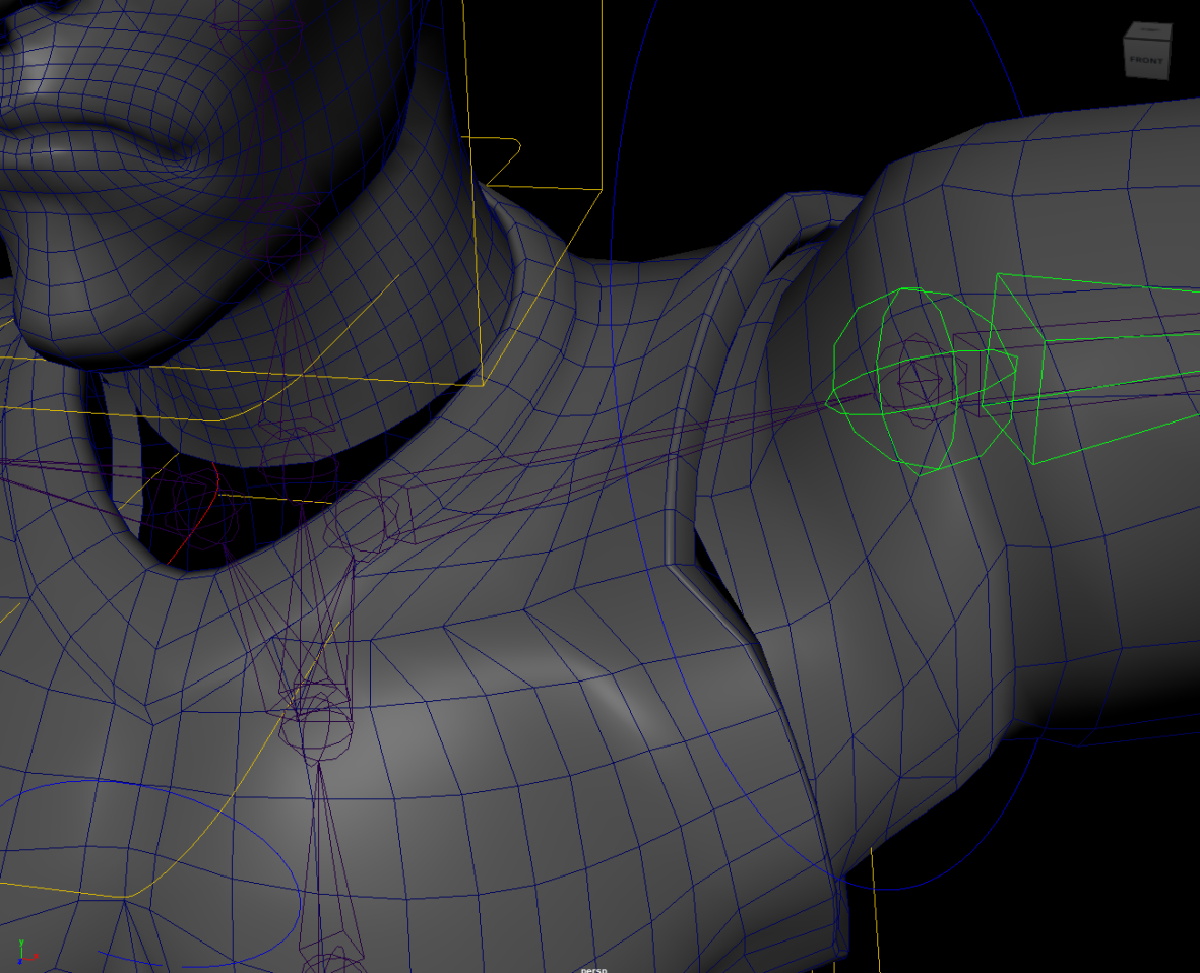
That’s why I’ve choosen skinning deliberately. It was both my weakest area, and the place where I could make the biggest leaps in understanding. I didn’t finish my skinning completely during the course, but that’s okay - as far as I understand - it was even expected of us to never finish it during the course. What I really gained is clarity. I now know exactly what steps to take next, which tools should & techniques should I use and how to reason through many tricky areas like armpits and shoulders:
I believe this was the key TD lesson: it’s not really about finishing a rig perfectly in one go, but about developing a problem-solving mindset (which from now on I engraved into my brain as TD mindset) - knowing how to break down challanges, and understanding where to focus effort for the most impact.
Growing pains#
Not all the difficulty came from skinning alone. One of the toughest weeks for me was the math-heavy understanding of Maya Nodes and what is happening under the hood of this software.
Look, I’m not totally clueless when it comes to maths - I’d say I rather enjoy it. I also did my Algebra I at University, but this is probably one of the first experiences where I could “touch” what I was learning back then (and see how much I forgot due to not using it!).
Matrix-bassed riggign concepts are everywhere now, I feel like all my social media focused on that back when I was reading all the theory - and I believe it’s really important to understand how the math works under the hood so you can make it useful later. It’s not about memorizing formulas (thanks, school!), but really internalizing how tranforms propagate, what a hierarchy really is and what a bone even is. Those concepts were challenging because you can’t see the progress immediately, but they were crucial to understanding rings (and space switching for example) at a depeer level.
On the skinning side, tricky areas like the shoulder-arm-chest triangle reminded me that some problems are always going to be hard. No amount of shortcutting could bypass these challenges: it’s just patience -> iteration -> observation -> repeat.
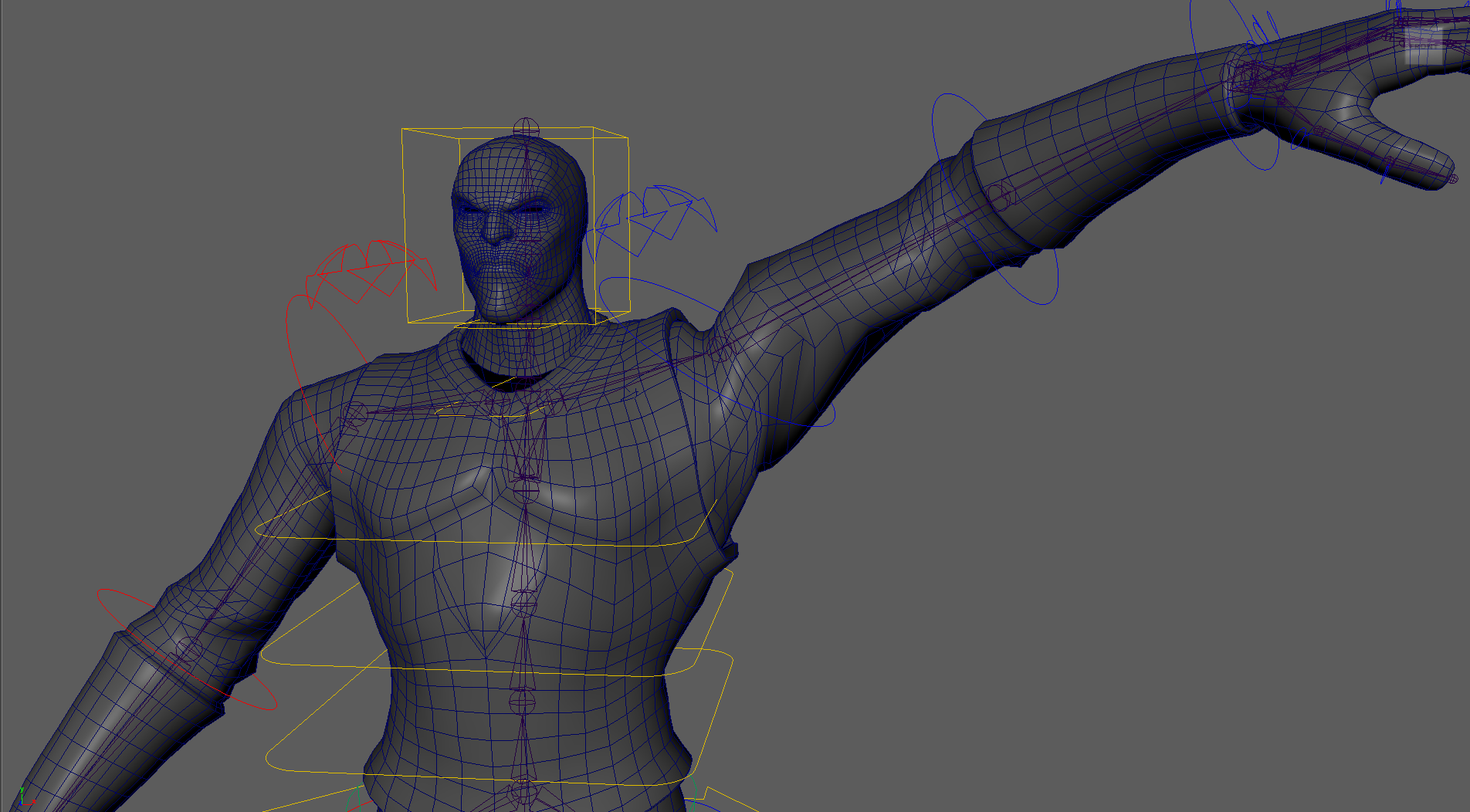
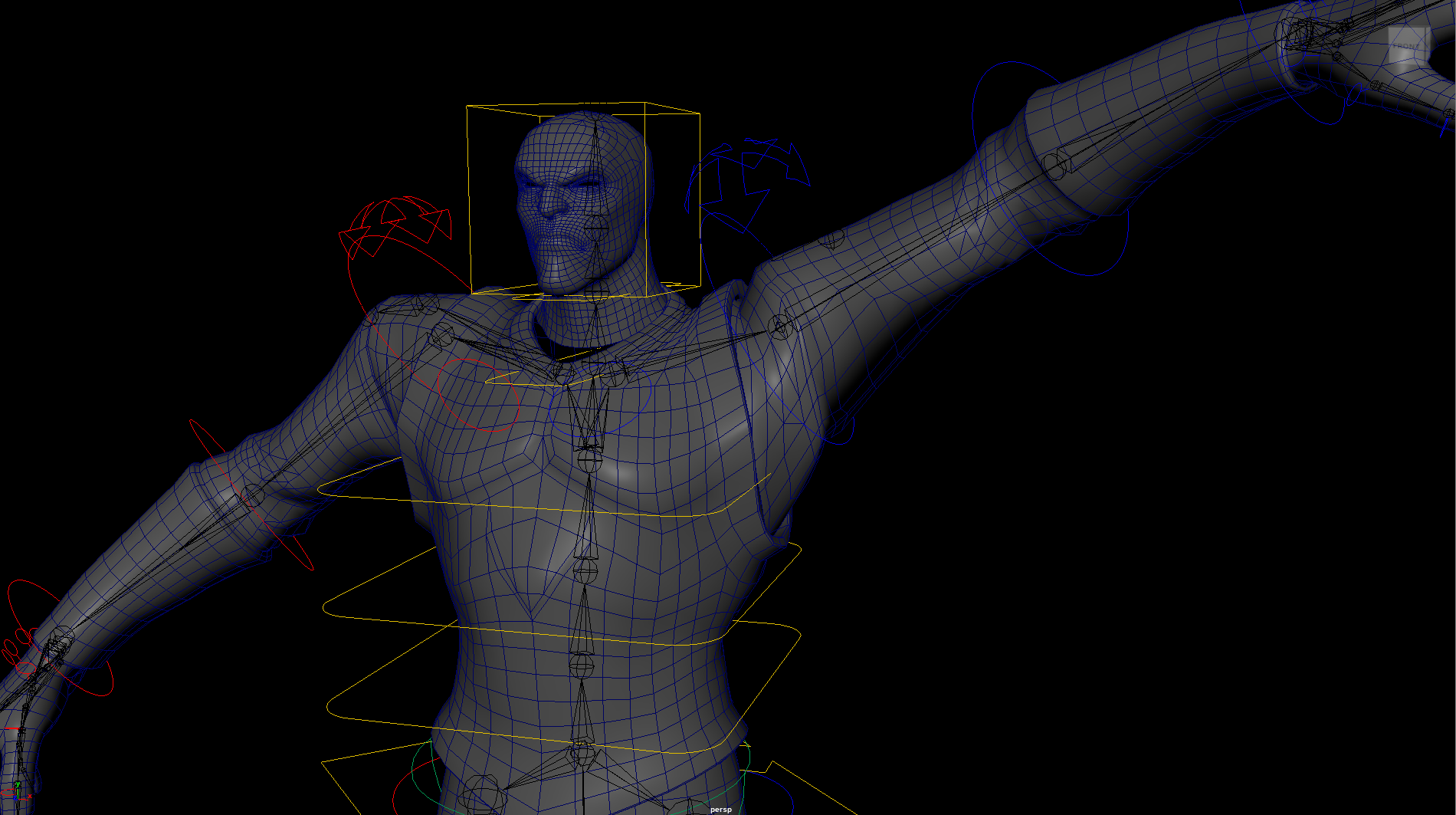
Overall, I felt like the workload was heavy, but motivating rather than discouraging. Every thing that broke, process that failed, tool that I’ve used incorrectly reinforced the TD mindset: the skill lies not in knowing everything, but in learning how to solve the unknown.
New Respect for Known Rigs#
One of the most rewarding outcomes wasn’t just the hand-skills I acquired, it is how I now look at rigs - both my old work & all the rigs I’ve learned how to animate on.
Looking back at my older rigs - I’m gentler on myself. I see that many limitations weren’t solely my fault - meshes, pipeline constraints, missing contexts - they all played a role in the effect.
At the same time, my respect for well-crafted rig has only deepened. You can probably think on a few(or more) “known” rigs that everyone uses to learn animation on - talking of all the AZRI’s (by the way Sol - I’m a huge fan of the work done here!!!) that students use. These rigs are all full of tiny, deliberate decisions that made them work s-e-a-m-l-e-s-s-l-y. I always knew these were high quality, but I feel like I never fully grasped how much though, iteration and problem solving it takes to reach that level of polish.
Once again, let’s repeat - TD Mindset: rigs are more than just technical constructions: they are a list of solutions to many complex problems. The difference between good-enough and well-crafted rig often comes down to thoughtful problem-solving, adaptability and knowing where to focus attention to.
Is this course for you?#
Rigging Dojo Character Rigging 101 is not a course for portfolio pieces. Period. The course isn’t designed for you to be hand-held to create a polished rig from start to finish, like in a factory. Brad, our mentor, often said:
You’re going to struggle. It’s normal, that’s how this course is designed. By struggle, you will learn.
– Brad Clark, Rigging Dojo’s Character Rigging 101 Mentor
And believe me - you’re going to struggle. You’ll feel stuck. You’ll feel frustrated. You’ll feel like it’s not doable. I know I did - and I’m grateful a great mentor had my back in these times.
As this course is about learning how to learn rigging, you’ll going to be experimenting, breaking things safely, testing the ideas and pushing your boundaries. It’s ideal for anyone who want’s to:
- Build a strong foundation in problem-solving
- Exploe new rigging techniques in a guided environment
- Develop judgement & adaptability in the context of a real pipeline
It’s less suitable for those seeking step-by-step instructions - but I’d argue that around 50% or rigging isn’t step-by-step at all - after all it’s case-by-case basis.
One unexpected takeaway was inspiration to push my coding skills & create my own tools. My whole idea of becoming a Technical Animator developed back when I was still studying animation - I was looking for some tools to help me with gimbal locks and I’ve found Morgan Loomis’s page with his awesome ml_convertRotationOrder. I was super hyped by someone (Come on, a Rigging Supervisor at this point) having their own set of tools they’ve let everyone else used. I wanted to have something like this too and I planned that one day I’ll have my own tool at my personal page… (that’s actually a reason why you can read this post!).
Some of the course materials had awesome TDs either creating basic things on the fly with MEL and PyMEL in Script Editor or straight up launching their own tools that they’ve built - not as optional extras, but as a natural extensions of problem-solving. With so many things I was doing taking many (2-3+) clicks in Maya, I’ve actually started noting everything that was uncomfortable to use so in the future I can start building my own shelf of tools and workflows. This is yet another aspect of TD mindset: identifying opportunities to improve efficiency and control through smart tooling, not just learning techniques.
Basically: if you do something more than 3 times a day, automate it somehow - that’s going to be my next goal.
TD Mindset & Closing Reflections#
If there’s one thing Rigging Dojo Character Rigging 101 taught me, it’d be this:
“TD mindset is all about finding answers to problems, not knowing everything”
The course wasn’t about memorizing workflows or finishing with a perfect rig. It was about thinking critically, experimenting, failing and solving problems - efficiently. Every challange - from tricky skinning areas, through controller mirroring with proper LRAs, to matrix-based riggign concepts - pushed me to approach the unknowns with curiosity, persistence and adaptability.
For me, the biggest shift isn’t just in technical skill. It’s in how I approach rigging now:
- I’ much more patient with myself
- I have a deep respect for every tiny, deliberate decisions on rigs I adore
- I actively think about how tools and workflows can extend my problem-solving muscle
- I approach challenges as opportunities to learn -> iterate -> improve
Rigging Dojo didn’t just strengthen my fundamentals - it changed the way I think - as a TD. That mindset is something I’ll carry forward int oevery rig, tool and problem I’ll tackle in the future.